“To invent, you need a good imagination and a pile of junk.”
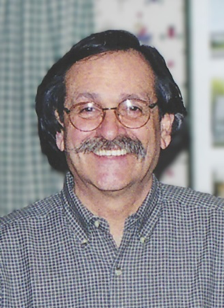
Allan and I met in 1986. Our meeting was serendipitous. I lived in Manhattan, and he lived in the same Long Island town as my family. My family was planning a Halloween party and discussing it at a local restaurant where Al and his German friend, Peter, were dining. My father spoke lustily about the lederhosen he’d wear when Peter walked over. “I’m German, are you?” “Yes. German descent,” and with that they bonded over their deutschstammig. Peter and Al were invited to the party.
The night of the party Al was recovering from dental surgery, and I was too work-exhausted to drive the forty miles. Neither of us intended to go. We both showed up. A serendipitous lederhosen encounter, and I met my life partner. I met a man who loved life. He was kind, intelligent, and creative—an electrical engineer, inventor, entrepreneur, artist, sportsman, boater and amateur race car driver. This was one of his favorite quotes: To invent, you need a good imagination and a pile of junk—Thomas Alva Edison
When we met he had a good imagination but no pile of junk. That would soon change.
The Car Racer
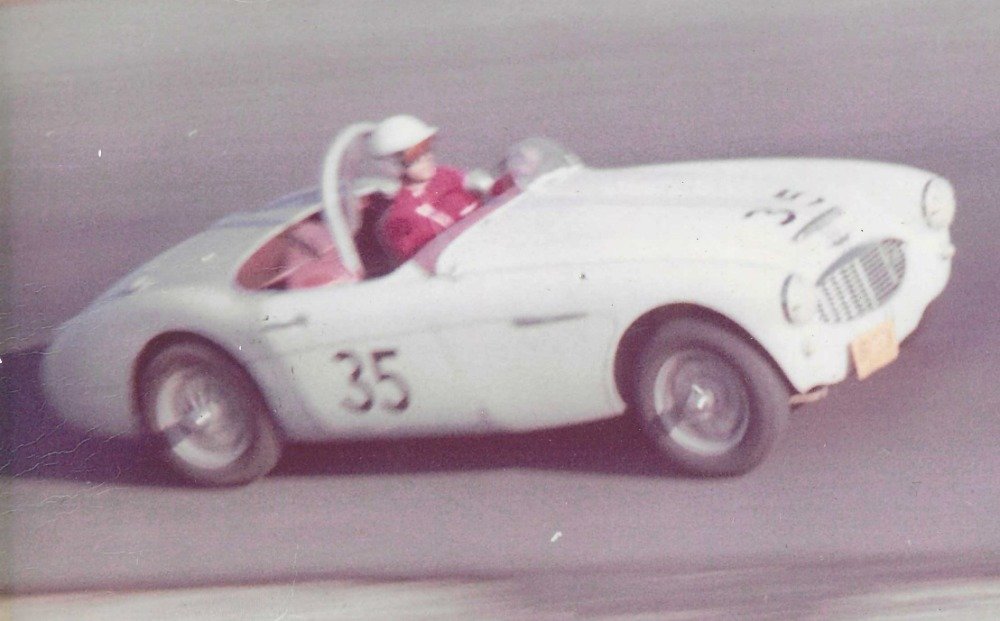
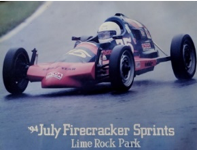
As a child he drove go-carts. As a young man, he raced an Austin-Healey 100-6. After we met, he raced two open-wheel Formula Vee cars and, after a crash on the daunting Bridgehampton track, he switched to a closed-wheel classic Mini Cooper. He drove the Mini on an autocross course, marked with orange cones that were changed for each event. In the morning, the driver walked the course and memorized cone placement. Drivers ran solo and relied on their concentration and motor skills. None of Al’s race cars had driver assists. He had exceptional concentration, memory, and motor abilities honed over a lifetime.
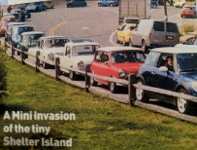
He loved life and he loved people, founding a Mini Cooper car club that drove around Long Island and brought out crowds of curious onlookers.
The Artist
His artistic skills flowered in midlife. Why? Perhaps it was the emergence of the creative fire that burned in his Italian forbears. His grandfather and maternal uncles were skilled sculptors. Perhaps it was his discovery of the genre of steampunk art, when we lived in lower Manhattan amid the East Village Art Scene. Steampunk—a cultural and artistic movement—endorsed the idea of retrofuturism. Steampunk artists envisioned a future that a 19th century person would envision, before electrification and digitization.
Like “outsider artists,” whose art he collected, he made art from “found objects.” His many interests coalesced, and he created small steampunk assemblages—fantastical creations—from his piles of parts. In one sculpture titled, Tuning Fork for Standardized Time Based on the Earths Frequency of 7.83 HZ, he connects with an unknown electrical universe. The piece contains a 1950’s rotary phone dialer and Ford ignition key steering wheel lock.
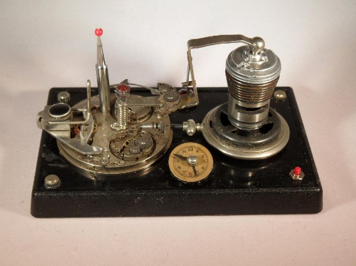
Tuning Fork for Standardized Time Based on the Earths Frequency of 7.83 HZ
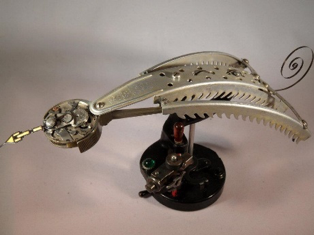
“Lace Winged Night Stalker”
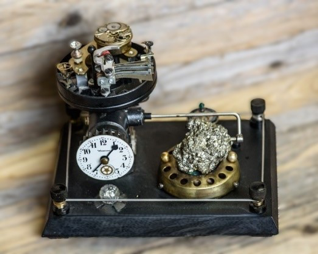
“LED Powered Recharge Station for Lace Winged Night Stalkers.” Based on an Eberhard watch (1917).
His Lace Wing Series opened a window into a fantastical world. The Lace Winged Night Stalkers were alien creatures with red eyes and probosces made from watch hands and springs. Their wings were 1930s hair curlers. His Lace Wing sculptures depicted their many occupations, including cloudseeding, fuel distribution, and the mining of diamonds, emeralds, and obsidian.
The Collector
He came from a large Italian family. There were artists and inventors in his lineage. His father held two patents and, he too, was enamored of patents and collected them. We travelled to junk yards and thrift shops and antique stores, searching for patented items from the 19th and early 20th century. He mounted them—more than a hundred of them—with their original patents and displayed them at invention conventions.
He taught patent theory, calling his talks The American Engines of Ingenuity.
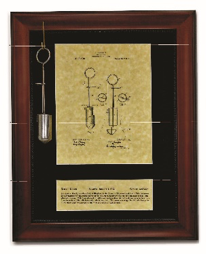
A Cream Dipper Patented Jan 2, 1912
The Entrepreneur
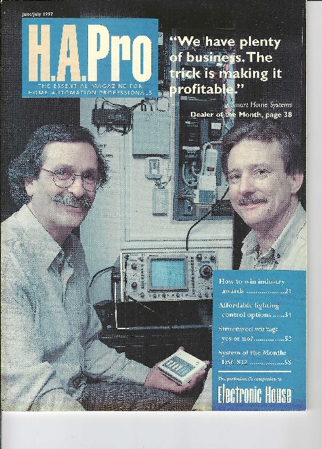
Al was an electrical engineer who worked for companies. He wanted to work for himself—to be more creative. In the 1970s, technology was burgeoning. There were cell phones and personal computers, VCRs and video games. Early home automation systems, like X10, enabled the remote control of appliances and home devices. Al was an expert in X10 technology. In the 1980s, the concept of “the smart home” emerged but was mostly available to the wealthy. He thought if he started a home automation business, he could expand availability. In the early 1990s—just prior to the heyday of home automation—he started a company called Smart Home Systems. He was a pioneer. In the next century, home automation would explode.
Such an intricate imagination. We shared these thoughts and imaginings, and they brought us closer. You can learn more about his joyous life and art when the book is published. The book is a remembrance of our life together—both before and during the illness. Some medical memoirs describe the struggle with dementia in detail, and the pre-dementia life is more of an aside. Or it is apportioned to the Appendix. I believe it should be the other way around. The person’s life is the main event, and dementia is a disease they acquire, like cancer or heart or kidney disease. It is not who they are.